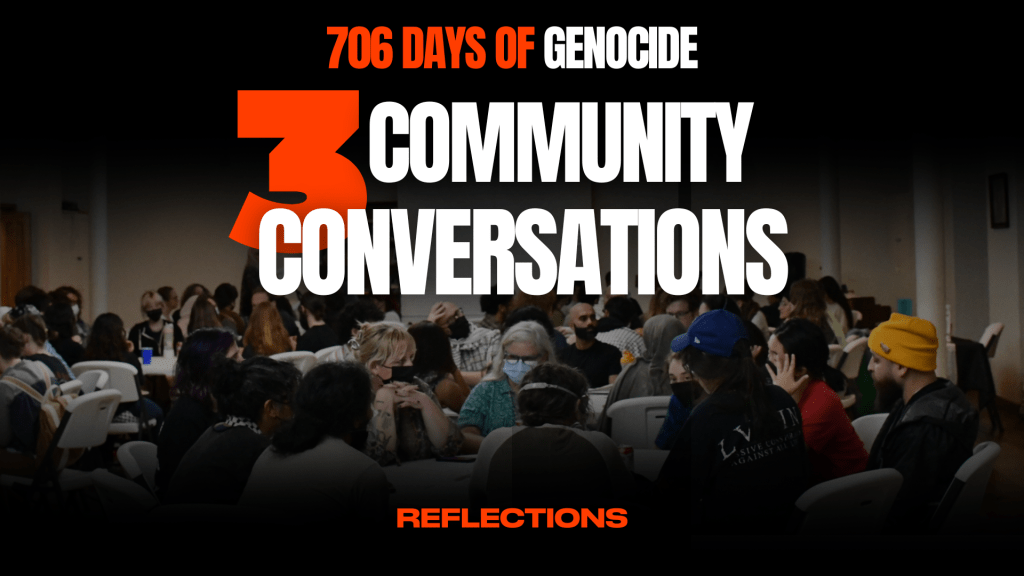
Since November 2024, Austin for Palestine Coalition, the Palestinian Youth Movement, the Party for Socialism and Liberation, and other organizations advancing the movement for Palestine in Central Texas have convened the community at critical moments. Routinely bringing in upwards of 100 people, our Community Conversations have served as grounding spaces to check in, to articulate feelings that are difficult to name, and to renew our commitment to the Palestinian struggle.
The Conversations comprise panels, breakout sessions, and Q&As. Not all are structured the same, as we’ve arranged them to answer questions that arise from a particular moment, specifically the one-year anniversary of Israel’s genocide of Palestinians in Gaza, the ceasefire agreement in January, and amplified state repression by the Trump administration. There are, however, common elements — we always begin with political grounding as a way to offer clarity to our community amid the incessant pacing of the news cycle and noise from our adversaries (often the institutions who govern the news cycle). Organizations both within and outside of the Coalition also have space for tabling to offer the community ways to become involved in tangible work. Above all, we’ve designed the Conversations to establish a direct line of communication among members of the community who seek a space to have political discussions.
After almost ten months of these Conversations — and two years into the Zionist entity’s genocide in Gaza — we reflect on what they’ve offered as we continue finding ways to meet the needs of both our people in Palestine and our local community.
The following reflection is written by the Palestinian Youth Movement- Central Texas:
Mobilization
“Revolutionary optimism is a wajib. It is our duty to remain optimistic and commit to the belief and surety that Palestine will be liberated. … Every time you feel yourself stop, it is a reminder that one of the oppressive systems is working on you. Even simply acknowledging this is a way to reject the psychic intrusion of isolation.” — Lara Sheehi at the First Annual People’s Conference for Palestine, May 2024
There is no right way to witness a genocide. Grieving, mourning, anger, and even pessimism are natural reactions to witnessing the attempted systematic destruction of Palestine.
Most of us feel the weight of demoralization. State and Zionist repression has become increasingly heavy-handed and violent, and it can feel like the state absorbs every tactic we throw at them. In times like these, when fatigue might be at its highest, it is vital to recontextualize our struggle. Our struggle toward liberation is long, as has been the case for many. Algeria was under French occupation for 132 years before finally declaring its independence on July 5, 1962. Vietnam’s resistance struggle culminated in victory in 1975, following nearly a century of foreign rule and three decades of resistance against French and American forces. Cuba’s prolonged fight for liberation culminated in victory in 1959, the result of centuries of resistance and organization.
The road is long, but we know that it has only one destination: liberation. Despite our opponents’ propaganda, the last 23 months have seen an unprecedented shift in global consciousness and monumental wins for the Palestine movement. After sustained pressure from the Palestinian Youth Movement and hundreds of thousands of people around the world demanding Maersk halt its shipments of weapons components to the Zionist entity, Maersk announced it will cut ties with companies linked to Israeli settlements in the West Bank. Locally, the Austin for Palestine Coalition’s efforts to pressure Austin Pride resulted in an organizational adherence to BDS guidelines, culminating in a reverse boycott by Zionist organizations. In November 2023, the Texas Statewide Protest brought together over 60,000 community members, marking the largest protest for Palestine in the state’s history. After months of sustained community pressure led by the Coalition, SXSW dropped all weapons manufacturers from its roster. The campaign included a kaleidoscope of tactics from petitions and call-ins to creative direct action. Over 120 artists and panelists pulled out of the festival leading to a massive gap in its programming. The striking success of this campaign inspired a similar one in London.
We need a variety of tactics to push our movement forward, including continued mass mobilizations. These are demonstrations of our collective power and a warning to the ruling class. When people take to the streets in large numbers, it becomes impossible for the state and the ruling class to ignore us. Even Israeli officials, including Netanyahu described the anti-genocide protests as “embarrassing” for Israel, reflecting the political pressure mass mobilizations create. Mirroring the mass demonstrations and political unrest of the Black Power and the anti-Vietnam War movements, the last 23 months of Palestine protests have played a critical role in shaping political consciousness and delivering material wins.
Our enemies want nothing more than for us to give into grief and anger, to convince ourselves that we are powerless. In the darkest moments, however, we remind ourselves that Gaza is our compass and Palestine is our lifeline. Revolutionary optimism is crucial: we will continue to fight, and we will win.
Organization
“One of the characteristics of mobilization is that it is temporary. Organization is permanent and eternal… If we’re not careful, we allow mobilization to become an event. The struggle is never an event. It’s a process, a continual eternal process.” — Kwame Ture
We have come to a moment in the struggle fraught with dejection and resignation. Not only have we reckoned with the weight of crying out against a genocide for almost two years, but since Trump’s reelection, the new administration wasted no time in unleashing attacks on institutions, the judiciary, migrants, anyone obstructing their agenda. This overwhelming sense of confusion from the onslaught of attacks is the result of a deliberate strategy that the right-wing has been perfecting for decades: shock doctrine.
First tested and utilized during Pinochet’s military coup of Chile in 1973, shock doctrine is a system by which leaders, whether democratically elected or not, manufacture or use crises in order to implement policies that benefit the elite class. Policies that negatively impact the working class are instituted at once, and so quickly, it becomes difficult to counter them. This is as much a psychological tool as a political one.
The current administration has clearly taken these lessons and used them to implement its unpopular and increasingly fascistic policies. Many people feel overwhelmed — in every Community Conversation, we’ve heard our community say that they don’t know how to fight back, that they feel an overwhelming sense of dread, that they want to do everything to stop this but are powerless. Shock doctrine stops many from acting and leads those who do so to burnout.
Still, we cannot lose hope. The best way to challenge stagnancy is by developing a political grounding that centers anti-imperialist struggle and a material understanding of the world around us. We must have sharp analyses not only of the tactics employed by the fascist right to suppress our movement but the liberal language that frames these crackdowns merely as an affront to our civil rights. When we understand that this overwhelming crisis is a strategy meant to immobilize us, we can begin to devise ways to oppose it without driving ourselves into the ground or being scared into submission.
Once we do so, we see clearly that this moment calls for us to sustain the fight for the long haul. Our enemies are organized; we must be as well. We must remain careful in choosing where we direct our time and effort and move thoughtfully, not in reactionary or defensive ways. Revolutionary struggle is asymmetric and long, requiring us to build an infrastructure of organizations and associations that work in lockstep.
Thankfully, we see the many opportunities that have arisen in response to the attacks on our communities by the Trump administration. At the second Conversation, many spoke about feeling overwhelmed not by the crises but by the number of opportunities to join an organization or become involved in one’s work. Community Conversations will always have spaces open for organizations to table so that attendees can find a political home. We encourage you to find one that is best capable of yielding the change you’d like to see.
Above all, it is vital to show up and take on work — advocacy and aid alone will not change our conditions. Channeling revolutionary energy into an ongoing commitment to struggle and conviction is how revolutionary change is made.
Joint struggle
“Imperialism has laid its body over the world, the head in Eastern Asia, the heart in the Middle East, its arteries reaching Africa and Latin America. Wherever you strike it, you damage it, and you serve the World Revolution. … The Palestinian cause is not a cause for Palestinians only, but a cause for every revolutionary, wherever he is, as a cause of the exploited and oppressed masses in our era.” — Ghassan Kanafani
Several Community Conversations involved discussion of the interconnectedness of our struggles. Zionism does not affect Palestinians or the Arab world alone: the Zionist entity has an active hand in imperialism across the world. Even a brief glance shows how Israel supported apartheid South Africa, supplied weapons and trained death squads in Guatemala, and today plays an active role in expanding carceral and surveillance technology.
Zionism, this system of ethnosupremacy, is a willing cudgel of imperialism and an enemy to liberation movements everywhere, including here in Texas. Zionists contribute to land grabs in Austin, expanding both gentrification and the construction of ICE facilities. Part of the redevelopment market also comes from the short-term rental (STR) companies like Airbnb. Airbnb is arguably the largest STR company in the world, and they explicitly support the violent expansion of Zionist settlements in the West Bank. Overpriced housing is subsequently bought up with highly paid tech workers, whose employers are highly complicit in the development and sale of military equipment and surveillance tech.
Elbit, Microsoft, Google, Palantir, NICE Systems — all of these tech companies are part of the weapons and surveillance industry, propping up the genocide of Palestinians and detention of working-class communities in the United States. The same surveillance companies tracking Palestinians for drone strikes also surveil immigrants at the U.S.–Mexico border and Black and brown working-class communities within U.S. borders. Until recently, private prison companies, like GEO Group and CoreCivic, who are deeply involved in the criminalization and incarceration of working-class communities here were the same actors criminalizing Palestinian resistance and existence.
In February, a new ICE detention facility was opened in Pflugerville. Organizing against gentrification in East Austin is integrally intertwined with the fight against settler colonialism in Palestine, as we are both fighting many of the same systems, logics, and actors.
Our liberation requires that we stand in joint struggle with all oppressed and colonized people: The fight for a free Palestine, from the river to the sea, is deeply and existentially connected to our fight against exploitation, gentrification, and oppression here. We must form a front against imperialism and Zionism wherever we are.
Repression
“Every small price you invest into resistance will yield great returns, if not in your lifetime, then in the lifetime of those who come after you. This is what we mean by resistance as an accumulative investment.” — Basel al-Araj
Over the last year, we have seen the lengths to which the ruling class will go to repress those raising their voices to stop a genocide. Our community — like so many others across the country — has experienced an onslaught of policies targeting Palestinians, Arabs, Muslims, and anyone standing against genocide. We have watched members of our community be snatched off the streets in broad daylight and swept away to detention centers thousands of miles from their families. We have seen organizers and organizations smeared with material support charges. At the most recent Community Conversation in May, our community expressed concerns over these attacks, the baseless revocations of visas, even the targeting of naturalized citizens.
Since the Zionist entity accelerated its genocide in Gaza, laying bare the homicidal nature of Zionism, the movement for Palestine has experienced tremendous growth. Millions of people all across the globe have come to political consciousness in this moment through the horror of the Zionist rampage in Gaza and the dystopian levels of repression their own governments have unleashed on them for demanding an end to genocide.
Our governments are meeting us with this level of repression because the Palestinian struggle is the litmus test for anti-imperialism — because we represent a global majority that poses an existential threat to the ruling class. All liberation struggles, from Algeria and Vietnam to the Panthers, Cuba, and Haiti, have faced (and continue to face) various methods of violent repression from the ruling class.
Repression is intended to stifle our revolutionary optimism — the deeply held conviction that we will be victorious, even if we do not immediately see the fruits of our labor. Revolutionary optimism is not idealism or naiveté. We fully understand the obstacles that stand between us and liberation and we must always ground revolutionary optimism in clear analysis. What destroys movements is not repression alone, but the chilling effect and defeatism it produces. So it is critical that we stay rooted in the conviction that we will win. Liberation is not a question of if, it is a question of when.
We cannot prevent repression from the ruling class, so we must move in smart and strategic ways. The Coalition’s Conversation in May equipped participants with tools and frameworks for remaining vigilant in continuing to organize and build.
Cases like the detainment of Mahmoud Khalil are put forward as examples to keep the rest of us in line, scared, and isolated, but we must remember that community is one of the most potent weapons we have in our struggle for liberation. It is the base of our power and a shield against repression. The law alone did not free Mahmoud Khalil — what freed Mahmoud was months of organizing work, mass demonstrations in cities across the country, dozens of protests with hundreds of community members outside of a deliberately remote Jena facility where Mahmoud was held, and the public outcry by hundreds of thousands of people. We can leverage the legal and legislative fronts strategically to defend community members and demonstrate that the state, while powerful, is not invincible. However, the law is not our primary tool, nor is it the most powerful one we have; the law is a tool of the ruling class and thus will not grant us liberation. The legal front can only be effective when paired with others, as only through community power and popular pressure can we gain concessions from the law.
Our work as organizers is to break through torpid individualism and build genuine bonds with each other. The robust community developed amid the Student Intifada shows us the power of the masses. Our ability to mount successful collective defense in the face of escalating attacks on our movement requires building wide networks, which means we may not always fully align on strategy or political lines with everyone involved.
Come for one, come for all is not a slogan; it is a promise to our oppressors that we refuse to be fragmented, to cow before repression. We walked away from May’s Community Conversation with clarity in how to find strength in our collective — we will remain united, we will always step forward to protect each other, and we will never lose the deep-rooted conviction that liberation is inevitable. We will never be defeated.
Moving forward
Remember what we are capable of when we join forces for Palestine. In the face of more repression, demoralization, and hasbara — a term used to describe Israel’s public image and propaganda efforts — we must remind ourselves that our strength lies in collective action.
It should be clear to us that we will win, that victory is inevitable. We, through our work, have pushed SXSW and Austin Pride to reject sponsorships from war profiteers; we’ve exposed merchants of genocide in our own city at Capital Factory and the Boston Consulting Group (BCG); we’ve traveled cross-country to join the masses in D.C., in Jena. Austin has demonstrated that popular pressure and organizing work. Our accomplishments are victories as much as they are lessons, showing us where and how we can continue pushing.
We must remain steadfast in the face of repression and resolute in our contributions to the movement for the total liberation of Palestine. From the belly of the beast, it is our duty to break down an empire without whom the genocide would cease. Our city has become a hub for the development of military technology and strategy that bolsters the U.S.–Israeli campaign of mass killing and starvation in Gaza; we must continue to confront the institutions that tie our community to this genocide, to make the crimes of companies like Capital Factory and BGC unignorable.
We move forward together, as there are different ways to actively participate in the struggle. We invite you to follow the Austin for Palestine Coalition’s work, attend cultural events and town halls, contribute to our member organizations’ campaigns, and help open new fronts against imperialism. The actions we can take to target the same systems that drive dispossession and violence worldwide — defending our community against fascist takeovers, organizing our workplaces, building mutual aid networks, and so on — are manifold.
Against all odds, remember that Gaza is our compass, Palestine is our soul, and liberation is not a question of if, but when. We have a responsibility to move forward with discipline and carry the same revolutionary optimism and unrelenting will that have brought us this far. Until full liberation.
Please join us for our next Community Conversation, which we hold every few months.
 Austin for Palestine Coalition
Leave a comment